

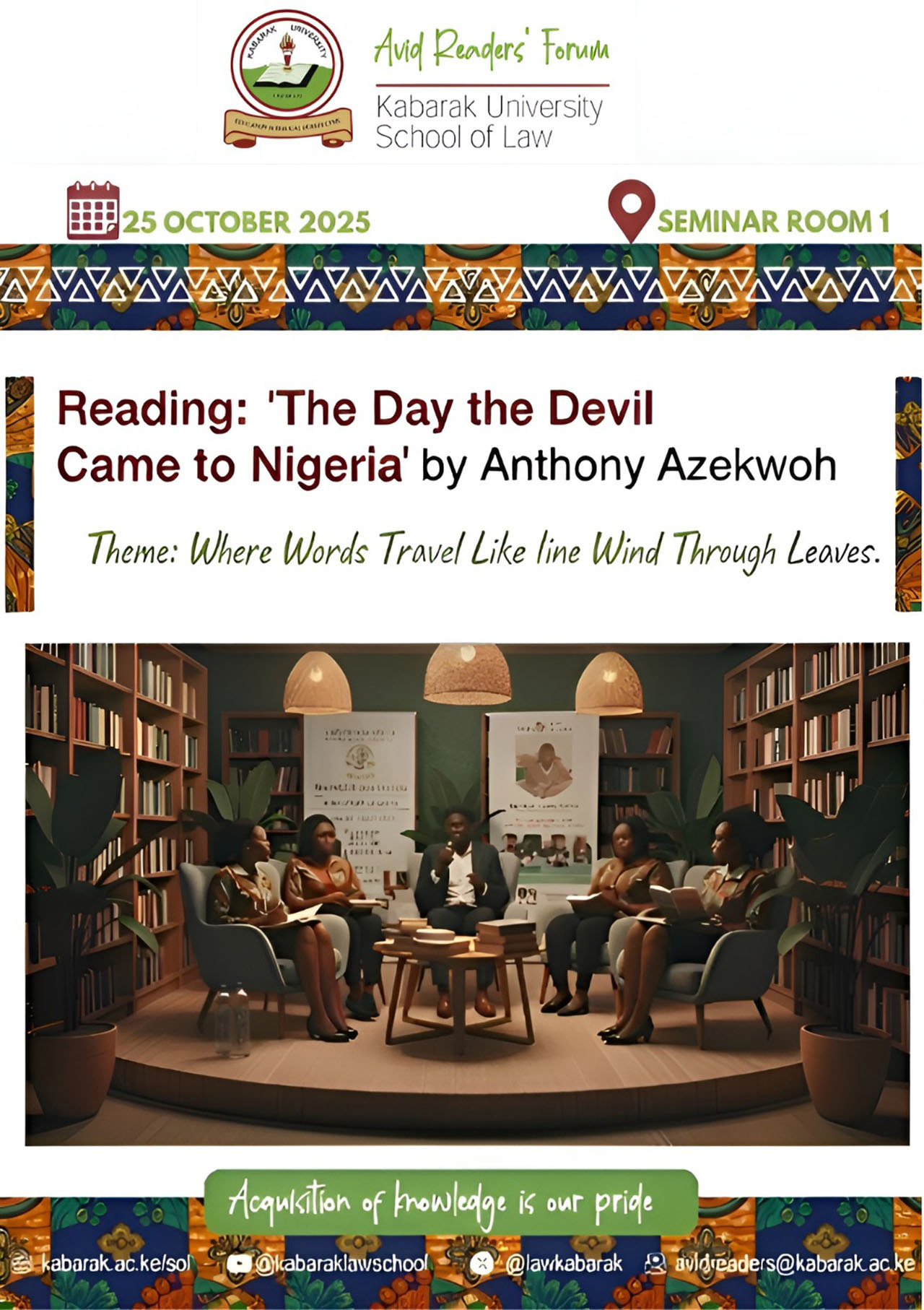
The Avid Readers Forum convened a reading and discussion session on Anthony Azekwoh’s short story “The day the devil came to Nigeria” on 25 September 2025. This session was led by Esther Blessing Nasimiyu and Victoria Okeke, two fourth year law students at Kabarak University, and attended by other participants including laws students. The session featured a collaborative reading of the story, where participants alternated in reading different sections aloud before moving into an analytical discussion.
The Reading Session
Anthony Azekwoh’s piece, “The day the devil came to Nigeria” employs dark satire and supernatural allegory to expose the profound corruption, religious hypocrisy, and societal decay plaguing contemporary Nigeria.
The narrative begins in hell, where Lucifer Morningstar, bored after millennia, accepts a challenge from a damned Nigerian soul named Karóunwı́. The soul claims that Nigeria surpasses hell in wickedness and wagers a day’s tour to prove it. Accompanied by the invisible devil, Karóunwı́ guides Lucifer through four emblematic locations. First, they visit a megachurch in Lagos where Pastor Philemon Joshua extorts the poor while amassing private jets. Karóunwı́ complains that the pastor took his wife and even became his children’s favorite father, referring to them as cows. The two then head to a Kaduna compound where a child bride is bartered for cattle and married off to an old man as his fifth wife. They also witness a mob lynching homosexuals with petrol and tyres and lastly a Borno massacre of students, raping women and burning property amid governmental indifference. The author criticizes democracy using the elections cycle, depicting rigged polls as a ritual that rubber-stamps the same frail leaders every four years while the masses endure unending cycles of suffering.
Through Lucifer’s growing disillusionment which culminates in his silent smile upon returning to hell, the story inverts traditional morality. This is because the devil, often a figure of calculated evil, is shocked by human depravity unchecked by conscience or consequence. Azekwoh critiques “fantastic corruption” not as abstract vice but as lived trauma. The story highlights different themes like betrayal, poverty being weaponised by faith, innocence being commodified, difference punished by fire and democracy rendered farce. The story’s epigraphs from Shakespeare, Dante and others frame Nigeria as a self-made inferno, where citizens “Arise o compatriots” only to perpetuate their chains.
In essence, the tale is a scathing indictment of postcolonial Nigeria’s moral collapse, where institutionalised greed, cultural regression, and political apathy create a hell more inventive than Satan’s.
The Discussion and Q&A Session
Once the reading concluded, the lead reader facilitated a lively and insightful Q&A discussion. Participants started off the discussion by appreciating the author’s employment of various stylistic devices like fantasy, satire and irony in describing the flaws and problems in society using Nigeria as an illustration, with other participants in agreement.
The discussion then shifted focus on the role of religious exploitation in perpetuating systemic inequality, as embodied by Pastor Philemon Joshua. Participants noted how prosperity gospel preys on the destitute, demanding tithes from those who “had only eaten twice that week,” while pastors accumulate fleets of jets mirroring real-world scandals that erode trust in faith.
The forum also examined gender-based violence and child marriage, highlighting the Kaduna scene where a girl no older than twelve is sold for cows and all the land they want. This prompted debate on patriarchal complicity and the failure of legal frameworks to protect the vulnerable, with participants linking it to broader statistics on child brides in northern Nigeria. This was also noted to be a reflection of the wider gender issue in Sub-Saharan Africa, and not just Nigeria.
Another key area of discussion was homophobic violence and societal hypocrisy. The tyre-burning lynching reflects on how mob justice fills the vacuum left by ineffective policing, while Karóunwı́’s personal confession his son’s sexuality leading to betrayal by the same pastor, exposed the intersection of religion and familial collapse.
The dialogue further scrutinised political dysfunction, with Lucifer’s confrontation at Aso Rock underscoring electoral fraud and leadership apathy. Participants debated the irony of a re-elected president amid massacres, drawing parallels to vote-rigging and thuggery during polls, and questioned whether democracy, as practised, enables rather than curbs iniquity.
In conclusion, the participants agreed that Anthony Azekwoh’s “The day the devil came to Nigeria” delivers a blistering satirical mirror to societal rot, using Lucifer’s outsider gaze to reveal how corruption, hypocrisy, and indifference have normalised hell on earth. Through Karóunwı́’s tragic odyssey and the Devil’s stunned retreat, Azekwoh underscores the urgency of accountability, empathy, and systemic reform in a nation that out-devils the Devil!
Conclusion
The session concluded with Ms Esther Blessing closing the discussion and inviting the student coordinator, Ms Victoria Okeke to give the final remarks. Victoria, together with Mr Cedric Kadima delivered a vote of thanks, expressing appreciation for the participants’ active engagement and consistent attendance. They commended the students for their analytical contributions and encouraged them to continue participating in upcoming reading sessions organized by the Avid Readers Forum.