

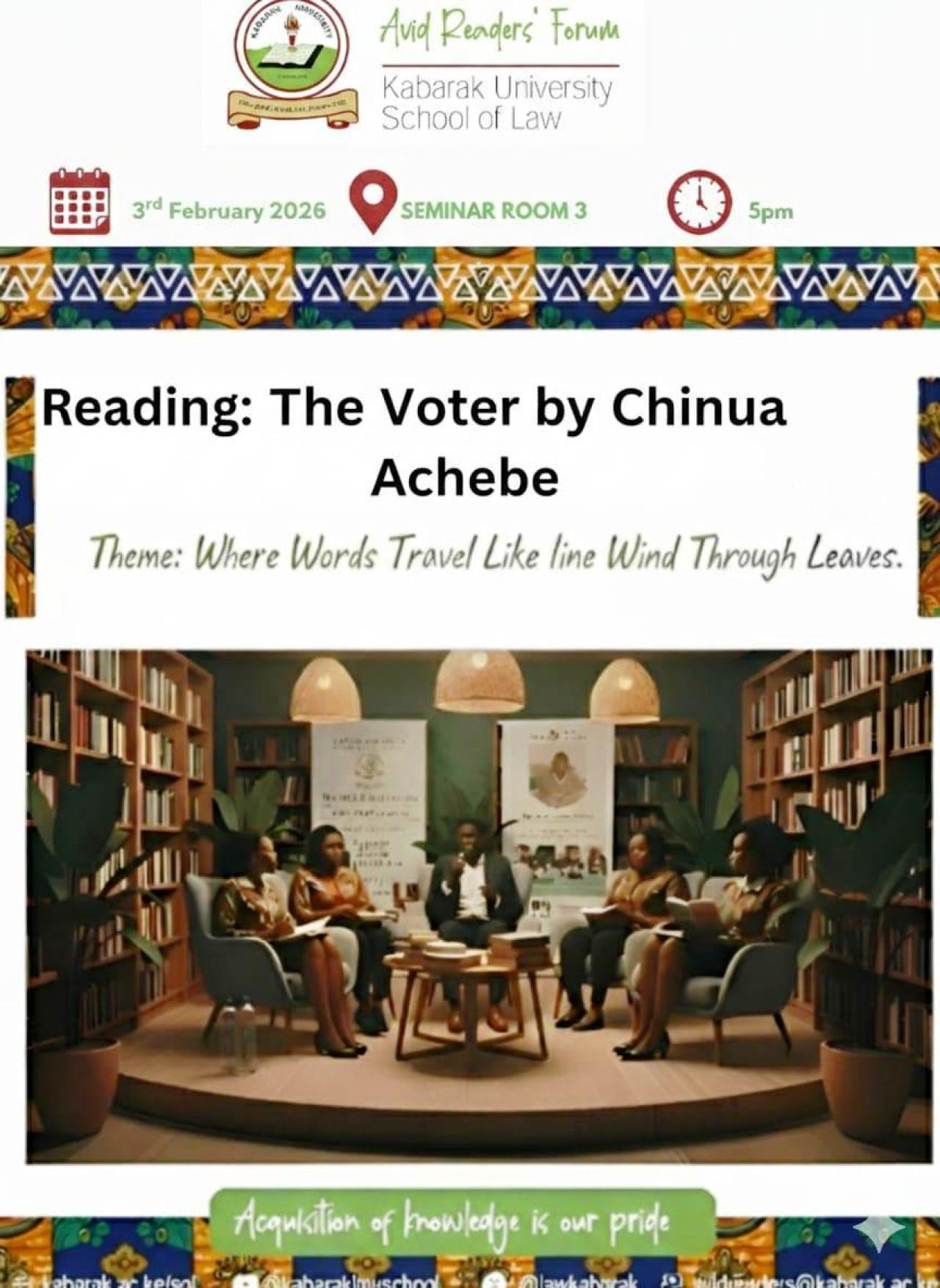
The Avid Readers Forum held its inaugural session this year on 3 February 2026. This session was moderated by Ms Victoria Okeke, the student coordinator and the lead reader. The selected text for the session was Chinua Achebe’s The Voter, a critique of the state of electoral politics in post-independence Africa. Before the reading, Barbra Chemwachar offered a brief background of Achebe, casting a spotlight on his central position in African literature. He is widely regarded as the father of modern African literature. Born on 16 November 1930 in Ogidi, Nigeria, Achebe was a novelist, poet and critic whose works profoundly shaped modern African storytelling. His first novel and magnum opus, things Fall Apart, remains one of the most influential African texts globally. She also shared two of his famous quotes, “If you don’t like someone’s story, write your own,” and “The world is like a mask dancing. If you want to see it well, you don’t stand in one place.”
The discussion
The reading proceeded collectively, each member taking a paragraph, turning the story into a shared intellectual performance. When the discussion began, the room came alive with ideas, thoughtful critique, and reflection.
George Skem connected the text to his research on ‘Elections without democracy’, shedding light on comparative authoritarianism, observing how systems across societies often adopt democratic language while operating through corruption and elite control. He noted how Achebe’s portrayal of political bribery and manipulation mirrors modern regimes where power is preserved through financial influence rather than public service. From this perspective, spaces for political contestation exist in form but not in substance, as they are systematically skewed in favor of incumbents.
The discussion highlighted how Marcus Ibe’s rise in politics transformed him from a modest teacher into a wealthy public figure, exposing how political success is often equated with material gain. This shows how public office becomes framed as a shortcut to wealth, a reality that strongly resonated with contemporary society, where leadership is frequently measured by sudden prosperity rather than accountability. It further traced this distortion of leadership to colonial history, arguing that the logic of extraction and accumulation introduced by colonial land dispossession continues to shape how political power is pursued and abused in postcolonial Africa.
The discussion then drifted to the notion that democracy itself has become a market transaction. It was observed that The Voter powerfully exposes the illusion of democracy in many African contexts, where elections offer the appearance of choice while power remains unfairly controlled. Votes are no longer voices of conscience but commodities to be exchanged for money, food, gifts and temporary favours. Building on these reflections, Victoria posed a challenging question, that of, whether democracy as currently practiced truly works for Africa, or whether alternative models of leadership and governance should be explored to deliver meaningful accountability and service.
A particularly disturbing moment from the text sparked reaction: the image of politicians throwing money onto the ground for villagers to bend and pick, a grotesque performance of humiliation masked as generosity. Members expressed how disturbingly familiar this spectacle felt within our own political environment in Kenya, where handouts replace policy and dignity is sacrificed for survival. The elders’ metaphor in the story, “…we have climbed the iroko tree today and would be foolish not to take down all the firewood we need”, was unpacked as the normalization of greed, where access to power becomes justification for exploitation. Corruption is no longer shameful but rather framed as wisdom.
Members then raised a provocative question about morality in leadership. Must one possess a scandalous character to succeed in politics? They referenced Marcus’s alleged scandal of impregnating a teacher and questioned why individuals with questionable pasts continue to be elected and remain in power. They connected this to our own regime, where individuals with criminal allegations often occupy the highest offices, shielded by popularity, tribe or wealth.
Another theme that surfaced strongly was the ideology of “our own people”, the tendency to elect leaders not on competence but on familiarity, ethnicity or communal loyalty.
The way forward
From a critique emerged reformative imagination. Members proposed transforming politics into a regulated profession like law and medicine, governed by academic qualification, ethics and merit. They went further, suggesting political positions be made so unattractive materially that only those driven by genuine service would seek them. It was proposed that leadership should function as a voluntary service rewarded by public appreciation rather than financial gain, a call to serve rather than a route to luxury.
In a voice that anchored the discussion, Cedric Kadima summarized this vision powerfully by describing politics to be a vocation, a calling to serve, not a ‘vacation’ for personal enrichment. In reinforcing this, he drew from Max Weber’s conception of politics as a vocation, recalling its earlier discussion during the third session of the Avid Readers Forum held on 13 November 2019. Victoria also reminded the forum that politicians are not detached from society but are products of it, reflecting the same values, compromises and moral contradictions present within the communities that elect them.
Members agreed that democracy without integrity becomes a marketplace; that poverty combined with ignorance breeds easy political manipulation and that politicians are often reflections of the society that elects them. If placed in power, many citizens admitted, they might act just as Marcus did, revealing how deeply corruption is woven into the social fabric.
Conclusion
Achebe’s The Voter is not merely a story, but a mirror held uncomfortably close to our faces. It exposes how leadership is auctioned, how conscience is negotiable and how democracy can be torn into half like Roof’s ballot paper. The inaugural Avid Readers Forum session succeeded in more than analysis; it sparked civic consciousness. It invited us to question power, confront complicity, and imagine better political features. The layered discussions from literary critique to historical inquiry and political theory affirmed that the ARF is committed to reading literature as a gateway to understanding power, governance and civic responsibility. As the year begins, the forum has set a powerful tone, literature not as entertainment alone, but as a tool of reflection, resistance and reform.
If literature is a lamp, then this first session lit a fire; and in that fire, we did not merely read, we reckoned.
Edited by: George Skem, ARF Senior Rapporteur & Finalist, at Kabarak Law School