

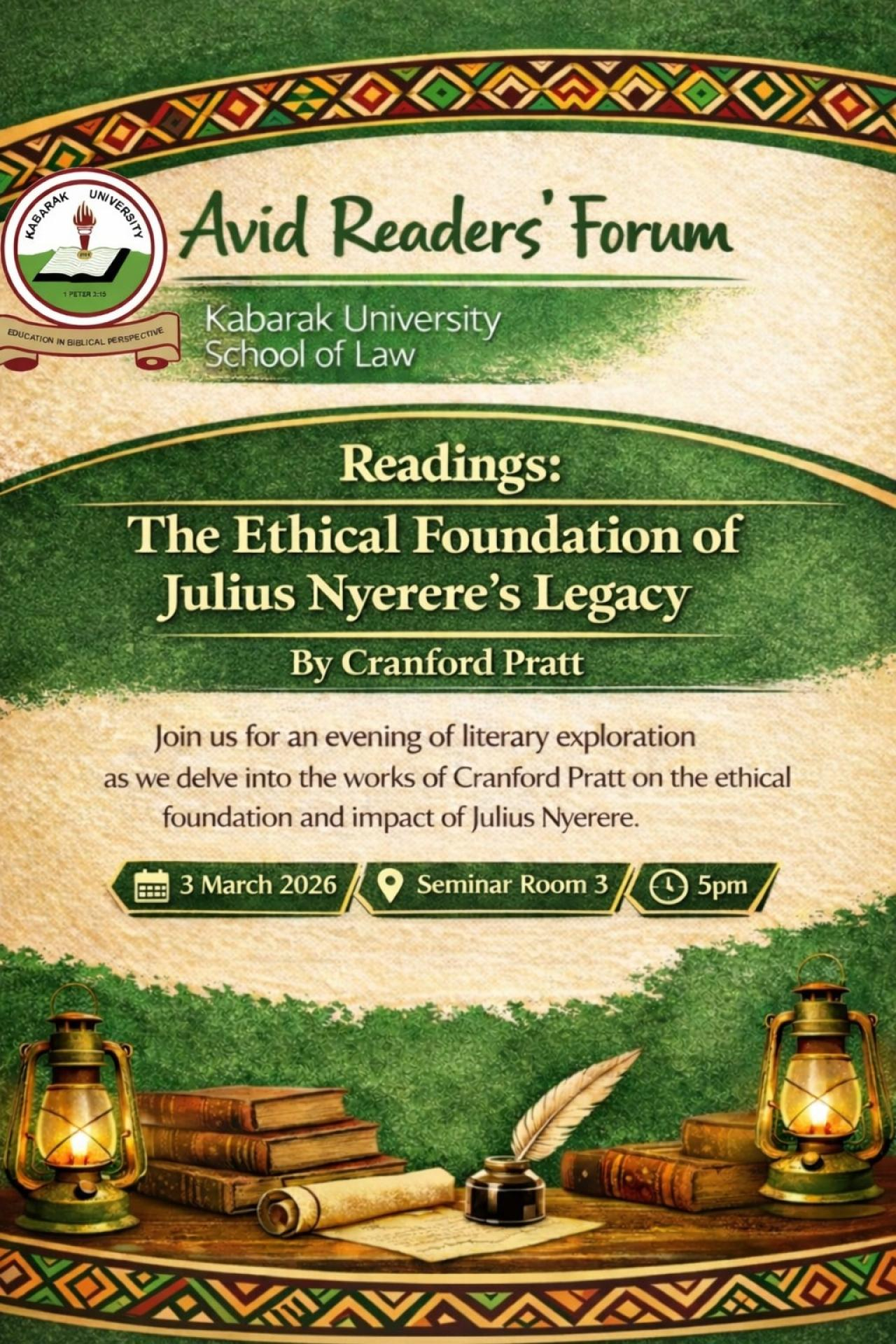
On 3 March 2026, the Avid Readers Forum convened for a reading and discussion session on Chapter 4 of The Legacies of Julius Nyerere and a substack article by Iain Parker. The session was moderated by Jimmy Wambua and Sarah Muhonja and attended by members of the forum drawn from Kabarak Law School, including Prof. Oluyemisi Bamgbose and Mr Cedric Kadima. With Parker’s article providing context, Pratt’s chapter explored key dimensions of Julius Nyerere’s intellectual, political and social legacy, with particular attention to his philosophy of leadership, education, and nation-building. Prior to the reading, the moderators provided brief contextual remarks on Nyerere’s role as Tanzania’s founding president and his enduring influence on African political thought and his emphasis on ethical leadership and collective responsibility.
The Discussion
The reading proceeded collaboratively, with participants taking turns to read sections of the chapter aloud, creating a shared and engaging intellectual environment. The discussion that followed reflected a deep engagement with the text and its broader implications.
Participants examined Nyerere’s conception of leadership as a moral responsibility rather than a pursuit of personal gain. It was observed that his insistence on integrity, humility and service stands in sharp contrast to contemporary political realities in many African states. Members reflected on how Nyerere’s model of leadership challenges prevailing systems where power is often associated with privilege and accumulation rather than accountability and sacrifice.
The discussion further explored Nyerere’s emphasis on communal living, equality and social justice. While some participants acknowledged its aspirational value in promoting solidarity and reducing inequality, others raised critical questions regarding its practical implementation and economic sustainability. The tension between ideology and practice emerged as a central theme, prompting reflection on whether Nyerere’s vision was undermined by structural and contextual challenges rather than conceptual flaws. Participants also explored the continued colonisation of African States through laws and practice such as in the corporate field, which is an import of the Western system.
Another key issue discussed was Nyerere’s commitment to education as a tool for liberation and nation-building. Participants noted his belief that education should not merely produce skilled individuals but responsible citizens grounded in ethical values and social consciousness. This sparked a broader conversation on the current state of education systems in Africa, with members questioning whether they still reflect these foundational ideals or have shifted towards purely economic objectives.
The chapter also prompted reflection on the relevance of Nyerere’s ideas in contemporary Africa. Members debated whether his philosophies remain applicable in modern socio-political contexts marked by globalization, technological advancement and shifting economic paradigms. While some argued that his principles offer timeless guidance, others suggested that they require adaptation to address present-day realities. Members also discussed the dangers of his attempt to enforce communalistic ideas in Tanzania, which may have unintentionally suppressed divergent political and economic views.
The Way Forward
From these discussions emerged a forward-looking perspective on the place of Nyerere’s legacy in contemporary governance and society. Members proposed that African states can draw from his emphasis on ethical leadership, social responsibility and inclusive development while adapting these principles to current contexts. There was a call to re-centre values such as integrity, accountability and community in both political leadership and public institutions.
Participants also highlighted the need to reimagine education systems in line with Nyerere’s vision, ensuring that they cultivate not only knowledge and skills but also civic responsibility and moral consciousness. It was suggested that revisiting such foundational philosophies could contribute to addressing persistent challenges of inequality, corruption and weak governance structures.
Conclusion
The session offered a compelling reflection on the enduring significance of Julius Nyerere’s ideas and leadership philosophy. The session demonstrated that his legacy is not merely historical but continues to provoke critical thought on governance, development and social justice in Africa. Through rich discussion and diverse perspectives, the forum reaffirmed its commitment to engaging literature as a means of interrogating societal values and envisioning transformative change. Victoria concluded the session on a reflective note, acknowledging that while Nyerere’s vision may not have been fully realised, it remains a powerful reference point for rethinking leadership and development in Africa today.