

Picture someone with 150,000 shillings in savings and a plan to open a mitumba shop in Kayole. She's hardworking, she's done her homework as best she can, and she's ready to leap. But there's a question she can't actually answer: is this the right place to open? Are there already too many mitumba shops on this street? Where does she even find suppliers she can trust? And if something goes wrong six months in, who does she ask?
This is the exact situation Emmanuel Kipchumba, a Kabarak University student, kept noticing over and over - not as a hypothetical, but as the real, repeating story behind why so many small businesses in Kenya don't survive. Between 60 and 70 percent of Kenyan MSMEs close within their first three years, and the honest reason usually isn't laziness or bad luck. It's that people are making serious financial decisions with almost no information.
"Farmers have cooperatives. Chamas exist for savings groups," Emmanuel explains. "But the person selling secondhand clothes in Kayole, or running an electronics stall in Eastleigh, has nowhere structured to ask a simple question like 'is this location any good?' They're guessing with their savings."
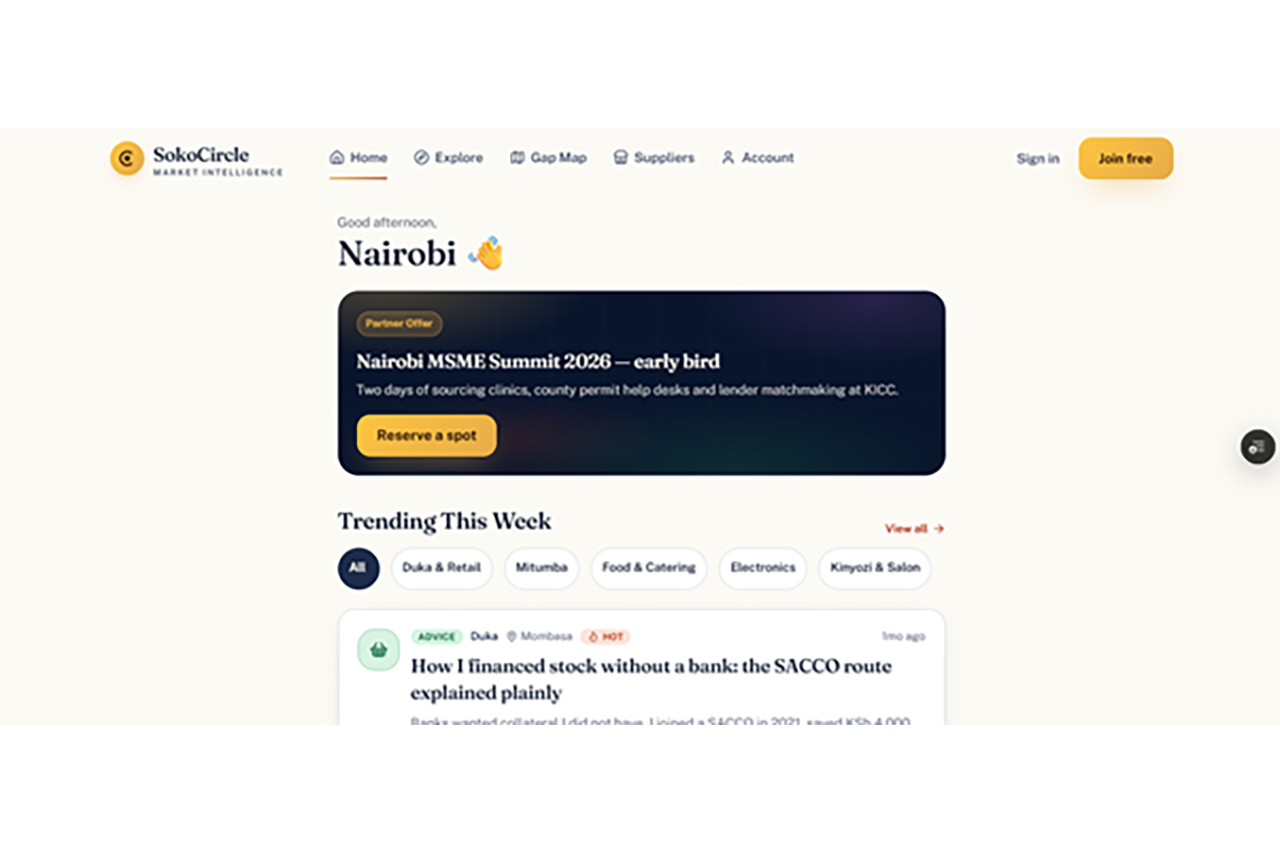
Out of that observation came SokoCircle, an idea for a platform built specifically around that gap. Instead of one big generic marketplace, SokoCircle organizes itself around county-based communities sorted by trade: mitumba, electronics, dukas, jua kali, and more. A beginner in Nakuru can drop into the Nakuru mitumba community and ask real, specific questions to people who've actually run that exact business, in that exact place, for years, not strangers in a WhatsApp group where good advice disappears under the next hundred messages.

The platform's ambitions go further than just conversation. It's designed to include a directory of suppliers who've actually been checked and verified, so new business owners aren't sourcing stock from someone they've only ever spoken to over the phone. It also aims to surface real market data - showing where demand for a certain kind of business is high and where it's already crowded, so people stop competing for the same corner and start finding the gaps that actually exist. And for anyone who wants deeper guidance, verified experts are available for consultations, giving access to the kind of insight that's usually expensive or simply out of reach for a first-time business owner.
At its core, the idea is almost stubbornly simple: most small businesses don't fail because people don't try hard enough. They fail because trying hard isn't the same as knowing enough. SokoCircle exists to close that specific gap, not with motivation, but with information.
A working prototype already exists, built and refined over weeks of development.